

In our search for self-understanding, we often ask ourselves: “Why do I make these choices?” or “Why do I react this way?” There’s a unique tool that can turn vague memories and scattered insights into a living map—personal history mapping. We believe this approach invites us to see our life story as an interconnected whole. Not a chaotic sequence, but a coherent process. It helps us wake up from life on autopilot and build presence in every moment.
Why personal history matters
Our behavior, emotions, and beliefs do not arise from nowhere. They are shaped by past experiences, memories, and patterns we have picked up on our journey. Many of these influences are subtle and do not always fit into neat categories. We think of personal history as the soil from which our current self grows. We have seen that by making this territory visible, even the most confusing emotions begin to make sense.
Tracing our story gives meaning to our present.
Mapping our history is not about blame or nostalgia. It is about understanding how past choices, family, culture, and even forgotten moments have contributed to the way we feel and act today. The aim is integration, not fragmentation.
Beginning the mapping process
So, where do we start? Here’s a step-by-step structure that we find helpful.
- Set the intention: We begin by clarifying what we seek. Do we want to understand a specific pattern? Or are we interested in the bigger picture of who we are?
- Create a safe space: Revisiting our history brings up many feelings. It’s best to give ourselves an undisturbed moment—maybe a cup of tea, calming music, or a journal.
- Choose your format: Some of us like mind maps, others prefer timelines, letters, collages, even audio recordings. There is no perfect medium. What matters is that it helps us connect with our own story.
- Start with key milestones: Early memories, important relationships, and major changes—good or bad. These points act as anchors.
- Expand with sensory and emotional details: The smell of a grandparent’s house, the joy of a first success, the tension before a move. These details bring color and depth, moving us out of dry facts into felt experience.
At any stage, we can pause, reflect, or even return to a particular episode later. The process is as important as the result.
What gets mapped?
We approach this not as analysts dissecting, but as explorers uncovering meaning. Here are areas we often include:
- Significant relationships: Parents, siblings, teachers, friends, rivals—anyone who shaped our view of the world or ourselves.
- Major events: Birthdays, moves, achievements, losses, transitions between schools or jobs.
- Family patterns: Rules, traditions, unspoken expectations, and the way emotions were expressed or hidden.
- Cultural and social context: The places we lived, the beliefs shared by our community, perceptions of “normal.”
- Emotional landscape: Times when we felt safe, ashamed, loved, or misunderstood.
It’s surprising how many influences reveal themselves when we pay attention. Sometimes, a single phrase from childhood echoes quietly in the present. Sometimes, a forgotten failure helps us understand our current fears.
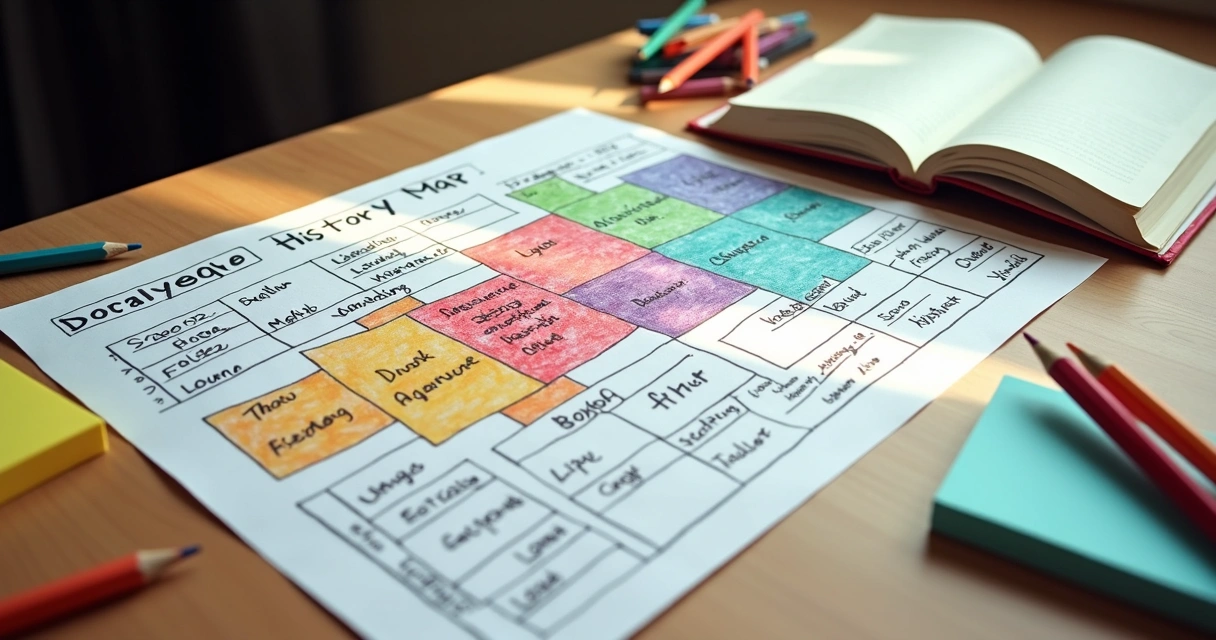
The value of seeing the whole
When we assemble these parts, something shifts. What seemed random begins to show rhythm. We can spot patterns—cycles of hope and doubt, repeated relationships, or moments where we changed direction.
Mapping our story lets us see not just what happened, but how it shaped us. For instance, when we connect a present anxiety to an old disruption, new possibilities emerge. We can respond, not just react.
Better choices come from deeper history.
This integration helps us take responsibility. It’s not about finding perfect answers or fixing the past. It’s about bringing our attention to the present, accepting the ground on which we stand.
What does mapping reveal?
We observe several benefits when we complete or even just attempt this process:
- Increased compassion: When we see our younger self struggling, we can bring understanding rather than criticism.
- Clarity of patterns: Recurring emotional states or habits become visible and less mysterious.
- Ownership of choices: We recognize areas where we have influence and where old scripts no longer serve us.
- Better boundaries and direction: By knowing where we’ve come from, it’s easier to choose where to go.
Sometimes, the map shows places we might wish to revisit—with curiosity, not judgment. These become invitations to growth.
Common pitfalls and gentle reminders
We notice that mapping can bring up resistance. Memories may be blurry or painful. We may fear judging ourselves. Here’s what we keep in mind:
- The map is never finished: Our story keeps evolving. What matters today might look different tomorrow.
- No memory is “too small”: Sometimes, the smallest moments are the most revealing.
- Feelings may shift: It’s natural to laugh, cry, or feel embarrassed. These reactions signal engagement, not failure.
- Comparison serves no one: Each map is as unique as a fingerprint. Our pace and detail are ours alone.
If things feel heavy, it’s wise to pause. A conversation with a good listener, or some time in nature, can help us reset for another step.

Applying what we learn
Completing a personal history map is not the end of a process but a new beginning. We now have a picture that can guide self-reflection. We think it’s helpful to revisit the map after a challenging week, a big decision, or even before important conversations. Patterns that once seemed hidden can become visible.
Integration replaces confusion with clarity.
With understanding comes choice. We see where old habits start, and we can pick new responses. We see the possibility to act with awareness, rather than repeating old scripts.
Conclusion
Personal history mapping is not a formula or a guarantee. In our experience, it is a living process that can deepen our self-understanding and support our maturity. It invites us to observe, connect, and make sense of the threads in our lives. We become the authors of our own story—not its prisoners. With patience, compassion, and attention, the map we create can light the way toward a more coherent, responsible, and meaningful life.
Frequently asked questions
What is personal history mapping?
Personal history mapping is the process of organizing and reflecting on significant events, relationships, emotions, and contexts from our past to better understand our present behaviors, feelings, and choices. By creating a visual or written map, we can see connections and patterns that may otherwise remain hidden or unclear.
How do I start mapping my history?
We suggest starting by setting your intention—choose whether you want to focus on your whole life or a specific area. Gather materials such as journals, art supplies, or digital tools. Begin with major life events or memories and gradually add emotional details, people who influenced you, and important places. There is no right or wrong way; the goal is honest reflection.
Is personal history mapping effective?
Many people find personal history mapping effective for increasing self-awareness and making more conscious decisions. It can help spot patterns, bring compassion to old reactions, and reveal where change is possible. Its effectiveness grows with honest engagement and ongoing updates.
What tools are best for history mapping?
We see people use various tools: journals, mind mapping software, timeline templates, scrapbooks, and even audio recordings. Some combine written maps with drawings or photos. The best tool is whichever helps you explore your past openly and keeps you engaged with the process.
How often should I update my history map?
Your map is a living document that can be updated whenever you gain new insights or experience meaningful life changes. Some choose to revisit their maps monthly or yearly, while others update after significant events or realizations. Consistency helps, but the rhythm is yours to choose.